
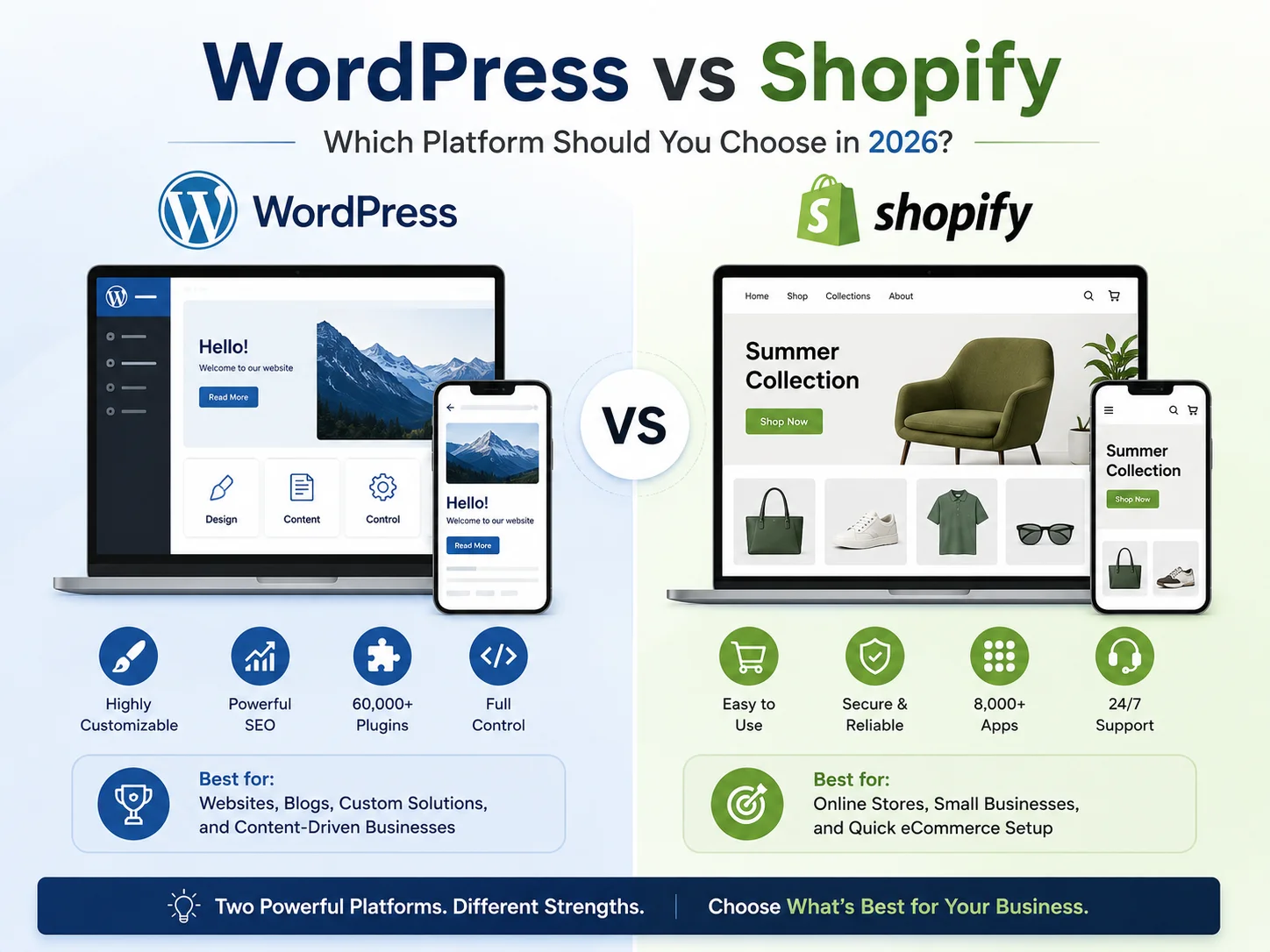
Choosing the right platform for your website or online store is one of the most important business decisions you’ll make. Two of the biggest names in the industry—WordPress and Shopify—continue to dominate the market in 2026. While both platforms are powerful, they serve different business needs.
If you’re planning to launch an eCommerce website, business website, or online brand, understanding the strengths and limitations of each platform can save you time, money, and future headaches.
In this guide, Oriosoft Technologies compares WordPress and Shopify to help you decide which platform is the best fit for your business.
What is WordPress?
WordPress is the world’s most popular Content Management System (CMS), powering over 40% of websites globally. It is an open-source platform that allows businesses to build everything from simple blogs to enterprise-level eCommerce websites using WooCommerce.
Best For:
What is Shopify?
Shopify is a hosted eCommerce platform designed specifically for selling products online. It provides hosting, security, payment integration, and store management in one package, making it ideal for beginners.
Best For:
WordPress vs Shopify Comparison (2026)
Feature | WordPress | Shopify |
Ease of Use | Moderate | Very Easy |
Customization | Unlimited | Limited |
SEO | Excellent | Good |
Blogging | Excellent | Basic |
eCommerce | WooCommerce | Built-in |
Monthly Fees | Low | Monthly Subscription |
Themes | Thousands | Premium Collection |
Plugins/Apps | 60,000+ Plugins | 8,000+ Apps |
Scalability | Excellent | Excellent |
Hosting | Self Hosted | Included |
Performance | Depends on Hosting | Optimized |
Ownership | Full Control | Platform Controlled |
Shopify
Shopify is built for beginners. Everything from hosting to security is managed by Shopify itself. You simply sign up, choose a theme, upload products, and start selling.
Pros
WordPress
WordPress requires hosting, domain configuration, and plugin installation. Although the learning curve is slightly higher, it offers much greater flexibility.
Pros
Winner: Shopify (for beginners)
WordPress
One of WordPress’s biggest strengths is unlimited customization.
You can build:
Developers can customize every section without restrictions.
Shopify
Shopify offers beautiful themes, but customization is more limited unless you modify Liquid templates or install paid apps.
Winner: WordPress
SEO is essential if you want free traffic from search engines.
WordPress SEO Advantages
Shopify SEO Advantages
Shopify Limitations
Winner: WordPress
Shopify
Shopify includes:
Everything works immediately.
WordPress + WooCommerce
WooCommerce offers:
It can be customized for virtually any business model.
Winner: Tie (depends on requirements)
WordPress Costs
Typical expenses include:
Overall, WordPress can be more affordable over the long term, especially for businesses that need extensive customization.
Shopify Costs
Shopify charges a monthly subscription.
Additional costs may include:
While setup is simple, monthly costs can increase as your store grows.
Winner: WordPress
Shopify provides optimized hosting with excellent uptime and speed out of the box.
WordPress performance depends on:
With proper optimization, WordPress can be just as fast as Shopify.
Winner: Tie
Shopify
Shopify manages:
WordPress
Security depends on:
A well-maintained WordPress website is highly secure.
Winner: Shopify
Both platforms scale well.
WordPress
Ideal for:
Shopify
Ideal for:
Winner: Tie
Pros and Cons
WordPress
Pros
Cons
Shopify
Pros
Cons
Which Platform Should You Choose?
Choose WordPress if you:
Choose Shopify if you:
Final Verdict
In 2026, both WordPress and Shopify remain excellent choices—but the best option depends on your business goals.
If your priority is flexibility, customization, SEO, and long-term scalability, WordPress with WooCommerce is often the better choice. It gives you complete control over your website and is ideal for businesses that want to grow without platform limitations.
If you want a simple, all-in-one eCommerce solution that gets you selling quickly with minimal technical work, Shopify is an excellent option.
At Oriosoft Technologies, we specialize in building high-performance websites and online stores on both WordPress and Shopify. Whether you’re launching a new business, redesigning an existing website, or scaling your online presence, our team can help you choose the right platform and deliver a solution tailored to your goals.
Yes. WordPress offers more advanced SEO capabilities, especially with plugins like Rank Math or Yoast SEO, giving you greater control over optimization.
WordPress is generally more cost-effective over the long term, while Shopify involves recurring subscription fees and potential app costs.
Yes. Products, customers, and orders can be migrated using specialized migration tools or professional services.
Yes. Shopify supports businesses of all sizes, including enterprise brands through Shopify Plus.
For businesses focused on long-term growth, content marketing, and SEO, we often recommend WordPress with WooCommerce. For businesses seeking a fast, low-maintenance online store, Shopify is an excellent choice. Our recommendation always depends on your specific business requirements and growth plans.